 Science
Biology
Evolution
Contact
Science
Biology
Evolution
Contact
| Don's Home
Science
Biology
Evolution
Contact
|
| Taxonomy | Eukarya (more phylums) | Evolution | Phylogenetic Trees |
Under Construction 
Contents: Human Ancestry | Diversity Time scale | Clades
Evolution of Man (Much of this is theory which is continuing to evolve.)
Biologists have long aspired to paint a genetic portrait of the ancestor by running the tree of evolution backward, going from its leaves -- the living creatures of today -- down to the point where all its branches coalesce in a single trunk. The rapid (geologically speaking!) diversification of the animals has made it difficult to establish the genealogical relationships between them. Some reptiles changed so that they could be active even when it was cool. These were the warm blooded cynodonts. They may have had fur to help keep them warm. They could feed at night when other reptiles could not. A new mammal, the primate, appeared about 65 million years ago. The monkeys evolved first and then the apes. Earliest Mammal Found 04/25/2002 mouse-sized shrew. Its discoverers date it at 125 million 50 million years older than the previous record holde most ideas and theory on animal evolution are based on:
ARCHAEA [Domain]
Bacteria (single cell, no nucleus) 3bya
Eukaryotes [Domain]
 Protozoa (Cells with a nucleus) 1.2 bya
 Animalia [Kingdom]
 Sponges [Phylum Porifera] (Grouping of cells in an organized colony) 0.8-1bya
    JellyFish (primative nervous system and muscles) 600 mya
     Coral
      Flataworms (Phylum Platyhelminthes)  600-1,000 mya
        (beginnings of a head - mouth and light sensitive spots)
       Brachiopods
       Mollusks [Phylum]
        Nautilus  550 mya
        Trilobites (High-definition eyes)
         Squid
         Echinoderms [Phylum] (star fish) 540 mya
           Lancet Family Alepisauridae (protofish) (Cephalochordata, Amphioxus 440 mya
         Chordata [Phylum] nerve chord.  570 mya
           Urochordata [Class] (Sea Squirts, Tunicates, Ascidians, etc.)
          Vertebrates [Sub-Phylum] 525 mya
            Agnathans are jawless fish. There are two primary marine types of the class Agnatha.
            They are Hagfish and Lampreys. 500mya 440mya
              Bony Fish - 470mya
              Fish  400 mya
             Coelacanth (Lungfish) 350 mya
              Tetrapods (terrestrial vertebrates - 4 appendages legs or legs+wings) 350 mya
               Amphibians
                Synapsida [Class]- (extinct) (looked like reptiles) (300 mya)
                 Pelycosaurs ("mammal- looked like reptiles") 290 mya
                  Therapsida [Order]- The dominant land animals during the Middle Permian.

                   Early Mammals [Class] (shrew like) 225mya
                    Marsupial (Opossum) 65mya

Early primates [Order] 50 mya
 Hominoids [SuperFamily] (Gibbons, ..) 20 mya
  Hominidae [Family] (Orangutans, ..) 15 mya
   Homininae [Sub-Family] (Gorilla, man, chimp) 12 mya
    Ardipithecus ramidus 4.4-5.8 mya
    Astralopithecus [Genus] 3-4 mya
      Anamensis 4.2-3.9 mya
      Afarensis 3.9-3 mya (Lucy)
      Africanus 3-2 mya
      Robustus 1.8-1 mya
    Homo [Genus] 1-2 mya
     Homo Habilis [Species] 1.6-1.9 mya
     Homo Erectus [Species] 300,000-1.8 mya
      Homo sapiens (archaic) [Species] 80,000-300,000 yrs
       Homo neanderthalensis 33,000 - 300,000 yrs
       Homo Sapien Sapien (Modern Man) 60-120,000 yrs
See: Human Migration, Kimball's A Phylogeny of Living Hominoids and Chart of Human Evolution at handprint.Skeletons in the cupboard - Science - www.theage.com.au Anthropology 3 at UC Santa Barbara
bya - Billion Years ago
First appearances and relative diversity (width of
shaded area) for major groups of animals.
Life evolved very slowely until the cambrian explosion about 530 million years ago.
Origins of Life:
1953 - Miller-Urey Experiment 2001 To answer the question of which came first a cell membraned or genetic molecules, Szostak, Bartel and Luisi's paper "Synthesizing Life" (Nature. 2001; 409: 387-390) state that a protocell and genetic molecule had to develop in parallel. Szostak at Mass. General has shown since how simple fatty acids around in the primative earth could form cell membranes.
2009 - Sutherland article in Nature
See also: Earth History and Extinctions. Phylogenetic trees: Cladistic trees, a system based on the a common evolutionary history to group "closely related organisms" has been accepted as the best method available for phylogenetic analysis since the early 2000's. | ||||||||||||||||||||||||||||||||||||||||||||||||||||
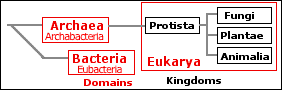 | Archaea was shown to be closer than bacteria to Eukayra (Protista, Animilia, Plante, Fungi) by comparing ribosomal RNA sequences. Carl Woese, 1977 See: Phylogenetic trees | |||||||||||||||||||||||||||||||||||||||||||||||||||
|
Clades for Humans: Links to Tree of Life Web (ToL) and Univ. of California Museum of Paleontology (UCMP):
DNA:
Scientists have been using DNA analysis to help in this excercise, but it has
turned out to be more complicated than they thought. A basic source of the confusion is that in the course of evolution whole suites of genes have apparently been transferred sideways among the major branches. Among animals, genes are passed vertically from parent to child but single-celled creatures tend to engulf each other and occasionally amalgamate into a corporate genetic entity.
Books:
See: | ||||||||||||||||||||||||||||||||||||||||||||||||||||


